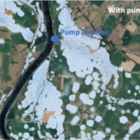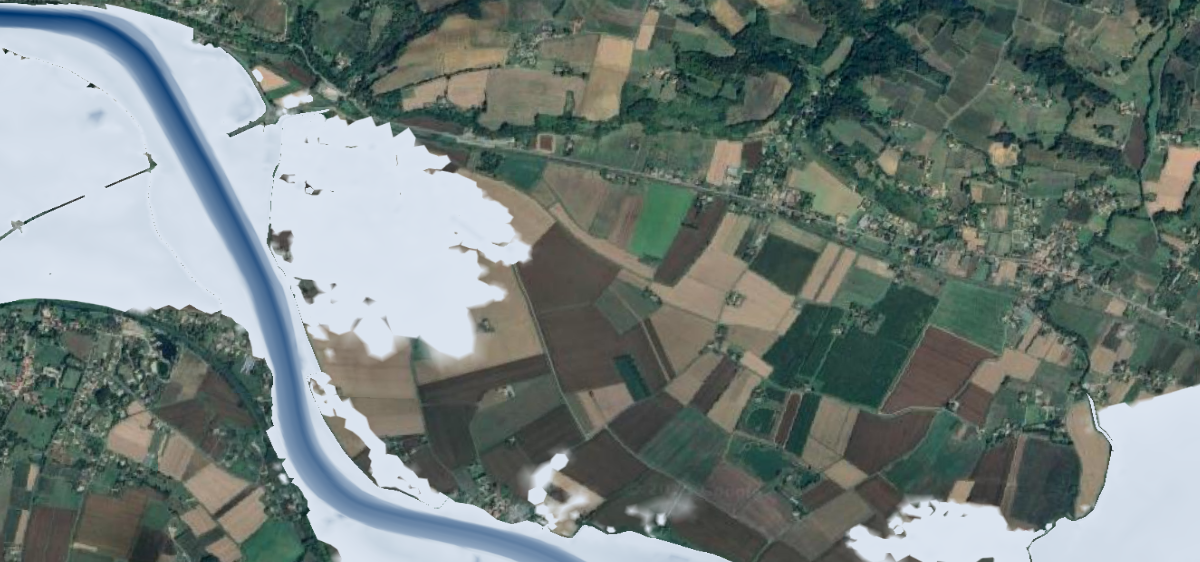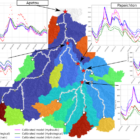
Example on the Maroni basin, French Guyana
- H&H calibration results
Figure 1: H&H assimilation algorithm. 1) The hydrological model provides distributed inflows to the hydraulic model. 2) Calibration of the hydraulic model (assimilation of satellite altimetry) and correction of the upstream hydrographs. 3) Subsequent calibration of the hydrological model, with corrected upstream inflows as observations.
Once the coupled model is built and the hydrological model is precalibrated (Step 1), two key choices remain for setting up data assimilation:
i) Choosing the assimilated data and the metrics by which to measure it fits to the simulated model response, which we will seek to minimize. Here, for the hydraulic model (Step 2), we use SWOT altimetry observations to calibrate the hydraulic model. For the hydrological model (Step 3), we use discharge at the 5 in situ gauges and distributed inflows inferred when calibrating the hydraulic model in Step 2.
ii) Choosing the parameters to infer, i.e. the ones we will change to reduce the cost function. Here, distributed friction and bathymetry, as well as 21 major inflows are sought in the hydraulic model (Step 2). In the hydrological model (Step 1 and 3), parameters and states are regionalized into 16 homogeneous areas and sought simultaneously (production and transfer reservoir capacities and initial states, linear reservoir routing coefficient, non-conservative subsurface exchange term).
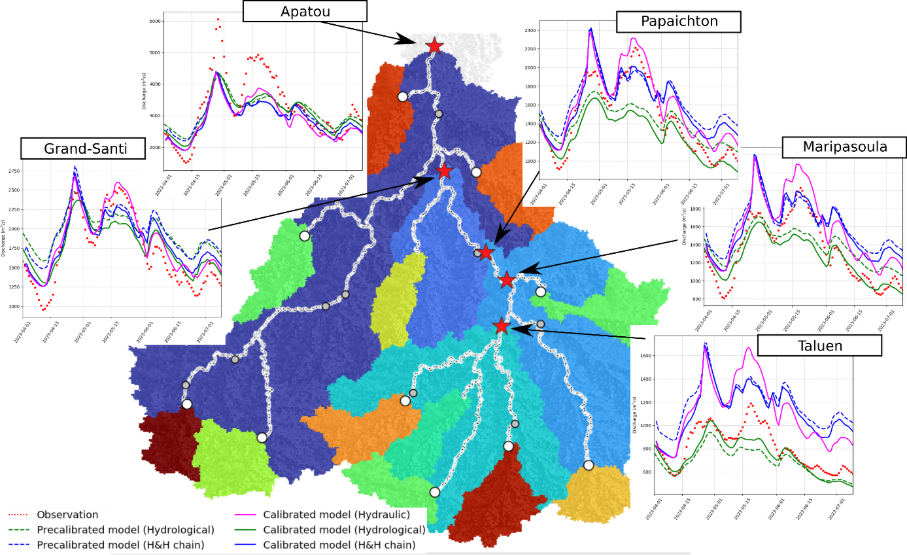
Figure 2: Modeled discharge at validation gauges after assimilation of SWOT daily altimetry into the H&H model. H&H outputs in blue. Hydrological model outputs in green (i.e. without hydraulic network routing). Hydraulic model outputs in magenta (this is an intermediate algorithm output, a visualization of signature backpropagation during Step 2).
The discharge simulated by the calibrated hydraulic model at the end of Step 2 (shown in magenta in Fig. 2) does not perfectly match the discharge from the fully coupled H&H calibrated model after Step 3 (shown in blue in Fig. 2). This discrepancy illustrates the role of upstream hydrology as a physical constraint on the inverse problem—limiting feasible hydraulic inflows to those consistent with the simulated hydrological basin response.
Ultimately, the H&H assimilation process improves model performance (in terms of NSE) at the validation gauges. This improvement arises from the combined effect of hydraulic calibration in Step 2 and hydrological calibration in Step 3, the latter involving substantial changes to the hydrological parameterization (see Fig. 3) due to information backpropagation from the river network to upstream hydrology.
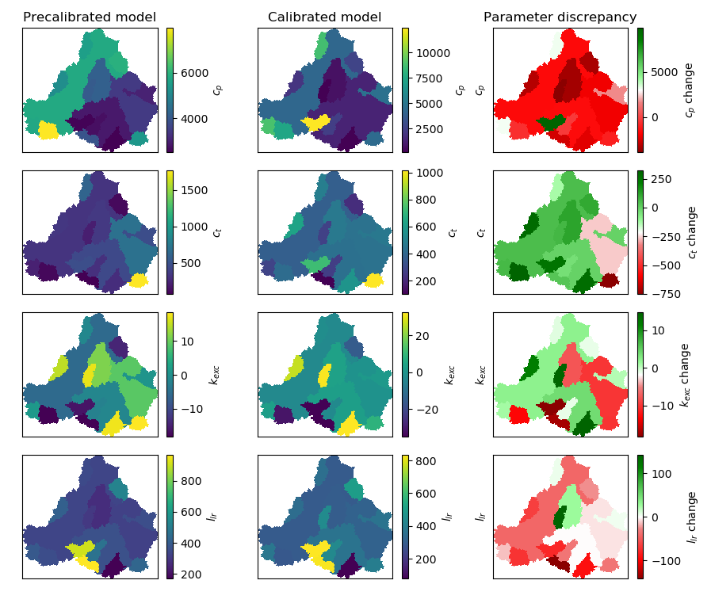
Figure 3: Value of the regionalized hydrological parameters before and after hydraulic-hydrological calibration.