
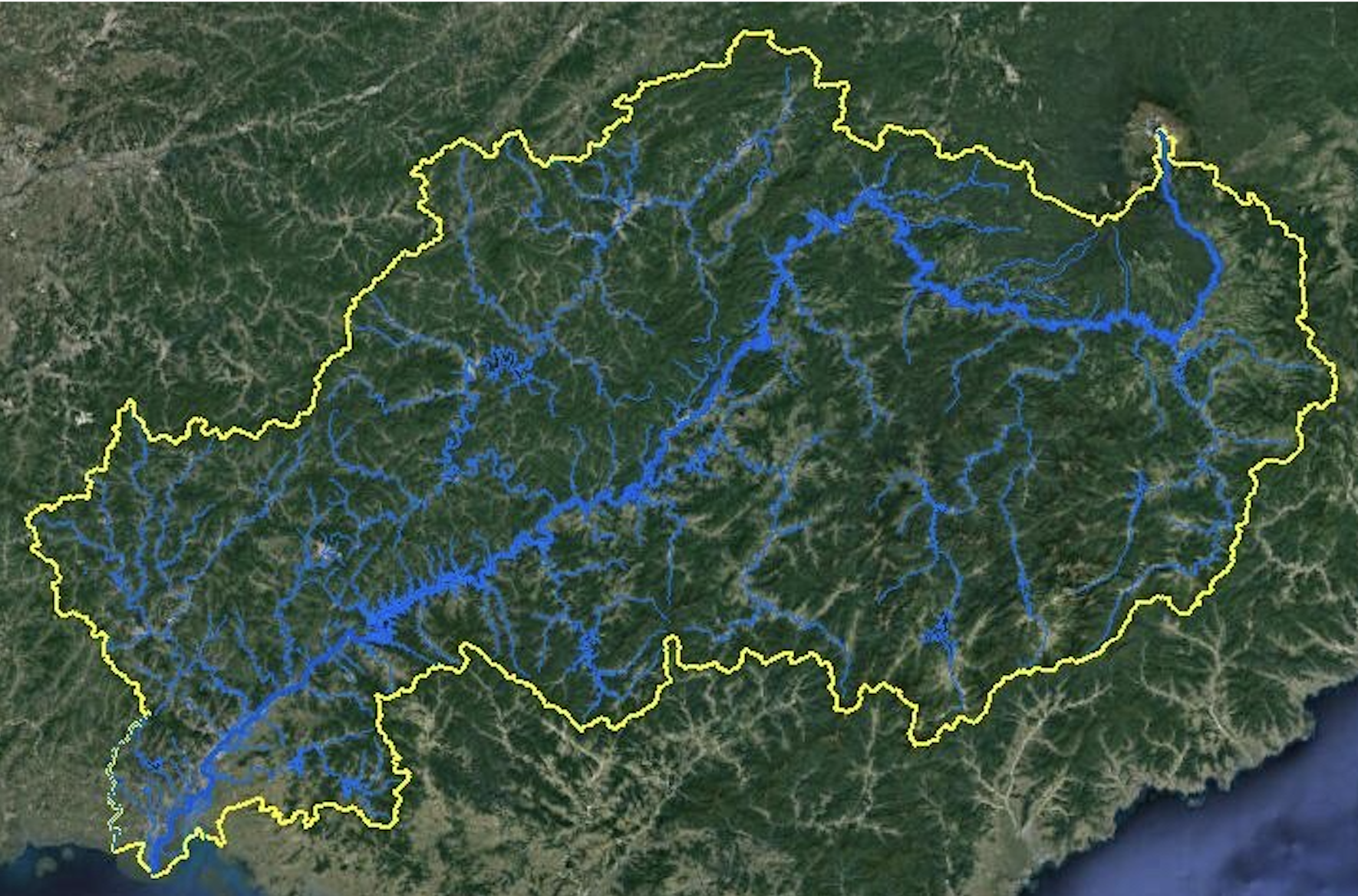
Differentiable, Regionalizable Hydrological–Hydraulic Framework for Learning from SWOT and Sparse Discharge Observations at Basin ScaleA Differentiable, Regionalizable Hydrological–Hydraulic Framework for Learning from SWOT and Sparse Discharge Observations at Basin Scale
A major research breakthrough in hybrid hydrological-hydraulic modeling has been achieved by the laboratories involved in the project and demonstrated in a pilot case study within the Hydr’Avatar project. By combining artificial intelligence, physics-based modeling, and SWOT satellite altimetry, the team has developed a novel data assimilation framework with the potential to substantially improve river flow forecasting in ungauged catchments.
A Cutting-Edge Hybrid ParadigmA Cutting-Edge Hybrid Paradigm
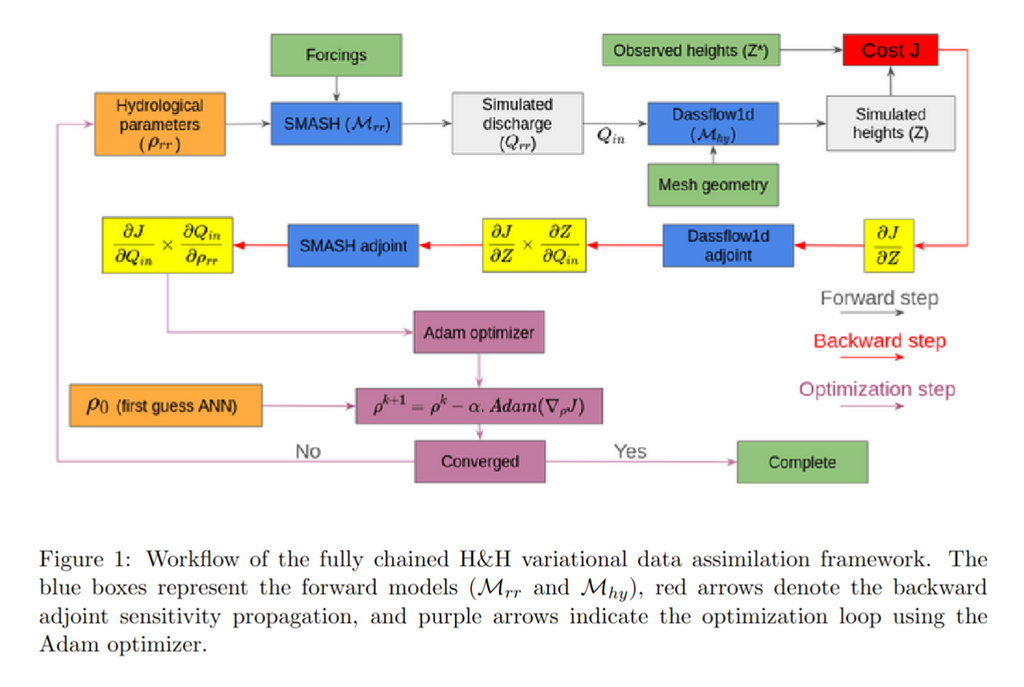
This new framework relies on the differentiable coupling of two core numerical engines:
- SMASH: A fully distributed rainfall-runoff hydrological model with learnable regionalization (Huynh et al. 2024) and flux corrections (Huynh et al. 2025, 2026).
- DassFlow-1D: A hydraulic river network model solving the 1D Saint-Venant shallow water equations for river flow and stage modeling.
The hydrological-hydraulic (H&H) framework is built around key concepts of hydrological closure (Larnier et al. 2025) and bidirectional information feedback (Pujol et al. 2022, Pujol et al. 2026). SMASH provides mass-conservative inflows that constrain hydraulic inference, while hydraulic observations and sensitivities feed information back to hydrology. Neural networks regionalize parameters, and differentiable coupling enables joint learning of H&H parameters from SWOT and sparse in situ discharge observations while preserving physical consistency of simulated states and fluxes at basin scale.
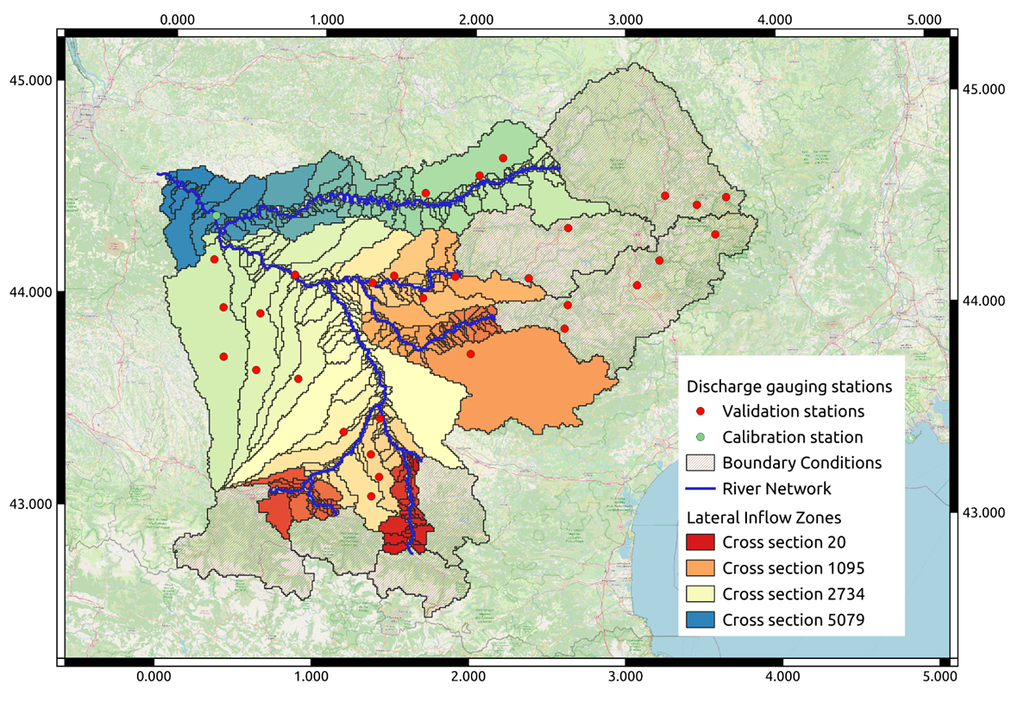
To bridge these models seamlessly, dedicated preprocessing aligns land-pixel lateral inflows from SMASH to exact injection points along the DassFlow-1D river network following (Berkaoui et al. 2026). Built within a PyTorch-based, gradient-aware environment using an adjoint-state formulation, the entire pipeline remains end-to-end differentiable via the chain rule. This allows river-level observation errors to backpropagate directly into the inverse calibration of regionalized hydrological parameters.
Proven Performance Across the Garonne River Basin